

Introduction
Singapore has officially formalised the Data Protection Trustmark (DPTM) as a national standard under SS 714:2025, integrating it into the country’s recognised standards framework.
For organisations that manage personal data, this change significantly increases the expectations.
The DPTM certification in Singapore has transformed from just a mark of reliability to a crucial asset in terms of competitive edge and compliance.
This guide explains what the standard requires, how it compares with ISO 27001 and Cyber Trust Mark, and how the EDG grant for DPTM can reduce implementation costs.

(Source: AI Generated Image)
Key Data Protection Statistics: Why SS 714 & DPTM Certification Matter for SMEs
Protecting personal data is no longer just a regulatory requirement but rather a business survival issue. As enforcement under Singapore’s PDPA strengthens and data breaches become more publicly scrutinised, SMEs face growing financial, reputational, and operational risks. Recent developments highlight why structured governance under SS 714:2025 and DPTM certification is becoming increasingly important. SS 714:2025 is the national standard that defines the technical and governance requirements for personal data protection, while DPTM certification is the formal assessment scheme that evaluates organisations against those requirements and relevant PDPA obligations.
Here are key data protection statistics Singapore organisations should take note of:
- The PDPC’s latest report confirms that cyber incidents are the leading cause of breaches, with a significant year-on-year increase in reported cases. Large-scale breaches reported to the PDPC saw a 41% increase in the most recent reporting period.
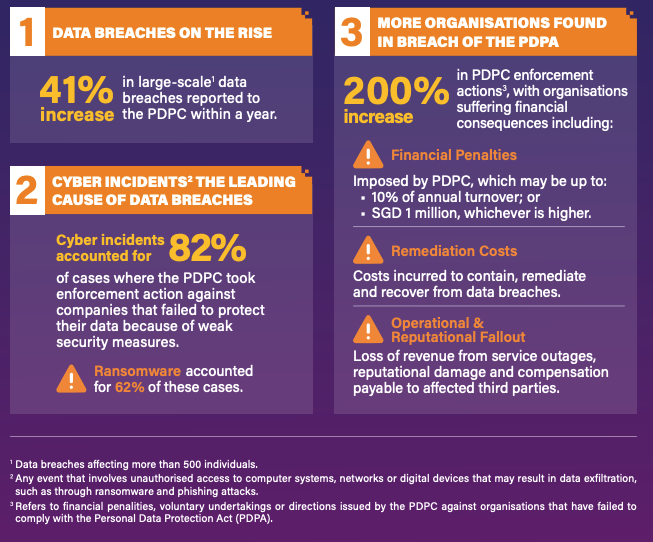
(Source: PDPC Singapore Data Breach Landscape)
- The maximum penalty was officially increased to provide a stronger deterrent for organisations with significant revenue. Fines can reach 10% of annual turnover (for organisations with >$10M turnover) or SGD 1 million, whichever is higher.
- The PDPC recently issued an advisory specifically targeting these “basic” lapses, noting that many breaches occur during system migrations or due to lack of monitoring. Over 80% of enforcement actions involve failures in “Protection Obligations” (security measures).
- Global and regional reports confirm that attackers are increasingly using “side-door” entries through partners. Approximately 35.5% of all breaches in 2024 originated from third-party compromises.
- The PDPC’s own surveys show a clear link between the Data Protection Trustmark (DPTM) and consumer confidence. 8 in 10 consumers say they prefer to purchase from DPTM-certified companies.
- IBM’s annual report remains the gold standard for these figures, showing that ASEAN costs are hitting record highs. The average cost of a data breach in ASEAN rose to USD 3.67 million (approx. SGD 4.9M) in 2025.
These figures reinforce a critical point: most data protection failures stem not from advanced hacking, but from governance gaps.
This is precisely where SS 714:2025 and the Data Protection Trustmark provide structured value. Rather than reacting to breaches, organisations adopt a proactive governance framework aligned to PDPA requirements and verified through independent audit.
When combined with EDG Grant Singapore support, SMEs can strengthen governance without bearing the full financial burden.
What Is SS 714:2025 Singapore?
SS 714:2025 Singapore serves as the national standard that supports the certification scheme for the Data Protection Trustmark Singapore. It addresses:
- Governance and responsibility measures
- Management of personal data during its lifecycle
- Risk evaluation taking into account potential harm to individuals
- Controls for data protection concerning third-party entities
- Ongoing assessment and enhancement.
The framework is not a comprehensive Information Security Management System, such as ISO 27001 Singapore, nor is it solely focused on cybersecurity like the Cyber Trust Mark. Instead, it is an organised governance certification centred specifically around the protection of personal data in accordance with the PDPA.
From IMDA DPTM to a National Benchmark
The previous IMDA DPTM program has changed into a recognised Singapore Standard. Key modifications include:
- Certifications conducted by organisations approved by SAC
- Annual audits are performed regularly to ensure compliance
- More detailed and extensive requirements
- Greater acknowledgement by regulatory agencies, Certifications carried out by organisations accredited by SAC
This change reflects enhanced supervision and an increasingly sustainable role within Singapore’s digital trust framework.
The Core DPTM Checklist: What Auditors Look For
At a practical level, organisations must demonstrate:
| Category | Requirements | Status (✓/✗) |
| 1. Governance & Accountability | Appointed Data Protection Officer (DPO) registered with ACRA/PDPC.Evidence of regular Management Oversight (e.g., minutes of meetings).Defined Roles & Responsibilities for staff handling personal data. | ✓/✗ |
| 2. Data Inventory & Mapping | Comprehensive Data Inventory (listing types of personal data collected).Documented Purpose Limitation (why data is collected).Clear Data Flow Mapping (storage locations & cross-border transfers).Defined Retention Policy (how long data is kept). | ✓/✗ |
| 3. Risk Assessment (SS 714) | Conducted Data Protection Impact Assessment (DPIA).Analysis of Risk to Individuals (not just the business).Assessment of Severity & Likelihood of data misuse.Documented Mitigation Controls for identified risks. | ✓/✗ |
| 4. Third-Party Management | Vendor Risk Assessment for all outsourced data processors.Data Processing Agreements (DPAs) with specific PDPA clauses.Proof of Ongoing Monitoring (e.g., annual vendor audits or declarations). | ✓/✗ |
| 5. Incident & Breach Management | A written Data Breach Management Plan.Escalation workflows to meet PDPC’s 3-day notification timeline.Logs/reports from Tabletop Exercises or mock breach testing. | ✓/✗ |
| 6. Monitoring & Enhancement | Schedule for Internal Audits or self-assessments.Annual Management Review of the DP Management System.Data protection Metrics (e.g., training completion rates, access logs). | ✓/✗ |
This organised DPTM checklist ensures that data protection is actively implemented rather than merely recorded.
How It Compares with ISO 27001
Many of the organisations that have been seeking ISO 27001 in Singapore have probably attained most of the required governance framework.
Reusable elements from ISO 27001:
- Risk methodology
- Internal audit process
- Supplier management
- Incident response
- Management review
Additional SS 714 focus areas:
- Detailed personal data mapping
- PDPA legal alignment
- Individual-centric harm analysis
- Full data lifecycle governance
In practice, SS 714 complements ISO 27001 rather than replacing it.
Why DPTM-certified companies have an Advantage
Appearing on the register of DPTM-certified companies signals:
- Verified PDPA-aligned governance
- Independent third-party audit validation
- Stronger enterprise procurement positioning
- Positive consideration under PDPC’s enforcement framework
For cybersecurity companies, obtaining such certifications might become a major requirement as part of CSA licensing routes by the year 2027.
The Role of the EDG Grant for DPTM
In today’s landscape, a significant competitive edge is access to funding support. The EDG grant for DPTM can help cover:
- Costs required for consultancy
- Fees required for assessments conducted by certification bodies
Through the EDG Grant made available to SMEs in Singapore, qualifying SMEs are able to obtain funding which can cover as much as 50% of their eligible expenses.
Why EDG Matters Strategically
Using the EDG Grant Singapore allows SMEs to:
- Adopt standards like ISO 27001 Singapore and SS 714 with reduced monetary strain
- Strengthen governance and board-level oversight
- Meet increasing customer and procurement demands
- Build long-term operational durability
- Compete more effectively in regulated sectors
Rather than viewing the certifications as high costs, EDG reinterprets them as a major transformation initiative that provides ample support.
For SMEs with 10 to 100 employees, the timeline and standards are as follows:
- Currently certified in ISO 27001: 2 to 4 months
- Solid PDPA basis established: 3 to 5 months
- Lacking a formal governance structure: 4 to 6 months
Strategic Posturing
SS 714 forms part of Singapore’s wider digital trust ecosystem alongside the ISO 27001 Singapore (information security governance), Cyber Trust Mark (cyber resilience) , and ISO 42001 (AI governance). Forward-looking organisations are bundling these into an integrated digital trust roadmap.
Final Thoughts
SS 714:2025 Singapore represents more than compliance; it is an organised approach to accountable personal data governance.
With funding available through the EDG grant for DPTM, there has never been a more practical time for SMEs to pursue DPTM certification in Singapore and become part of the ranks of recognised companies DPTM-certified.
If you are exploring how to align your organisation with the Data Protection Trustmark Singapore framework or how to structure your project to maximise EDG Grant Singapore support, contact Artan Consulting for a practical, implementation-focused discussion.